Method ledger / 01 · Drying
Wind and the Drying Rack
A seasonal catch became a travelling food when coastal communities learned how to enlist the air.
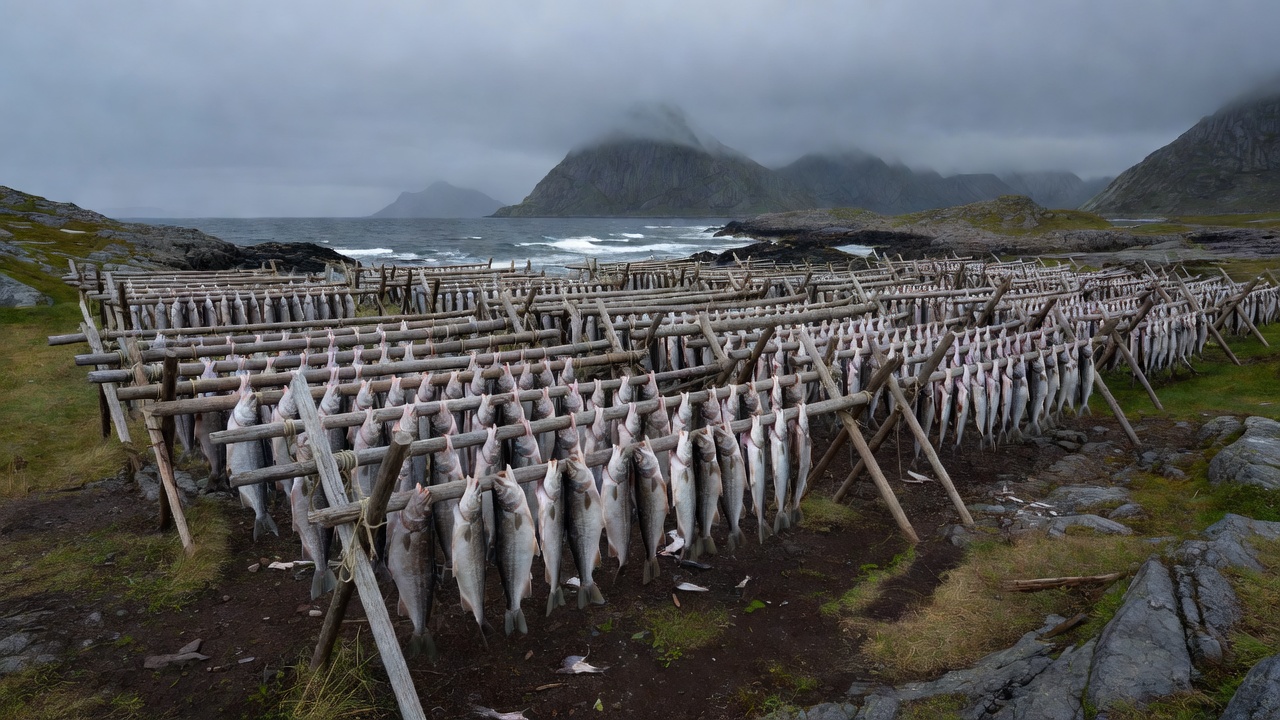
The first fact in the drying ledger is not a technique but an arrival. Migrating Atlantic cod brought concentrated fishing opportunities to northern Norway. A catch too large for immediate consumption could become a problem unless it was carried into another season. Drying offered one answer, using the relationship between cold conditions, moving air and careful handling rather than an unlimited supply of purchased salt.
Lofoten is central to this history because its fisheries and drying landscapes remain unusually legible. Timber racks are not simply picturesque structures beside the sea. They are working infrastructure, arranged within a particular climate and connected to landing places, labour and commercial judgement. A visitor sees fish hanging in the air; a producer also sees changing weather, differences in raw material and the condition of a valuable stock.
What the word stockfish leaves out
Stockfish generally means fish dried without a preceding salt cure. Cod is especially important in Norwegian commerce, but the category should not be reduced to one photograph or one species in every setting. Drying removes water and changes texture, weight and handling. It does not make every piece of fish equivalent, and the name by itself is not a modern storage specification.
The distinction from klippfisk matters. Klippfisk is salted and dried, historically associated with drying on rock surfaces and later with other drying arrangements. A market display can place the two close together, yet their production histories differ. Confusing them also hides an economic difference: salt had to be obtained, transported and paid for, while unsalted drying drew differently on local environmental resources.
From a rack to a trading network
Dried fish could move beyond the household because removing water reduced the burden of transport and supported keeping under appropriate conditions. Bergen became a major node in the stockfish trade, connecting northern fisheries with merchants and overseas demand. The Hanseatic presence at Bryggen belongs to this larger story of exchange, storage, credit and commercial power, not merely to the appearance of surviving wooden buildings.
Trade also changes the meaning of “local food.” A fish caught and dried in northern Norway might acquire culinary significance far from its original shore. Italian stoccafisso traditions are a reminder that preservation created relationships between distant kitchens. The product’s history is therefore both regional and international: local weather helped make it, but merchants and consumers elsewhere helped shape its value.
Icelandic dried fish at another scale
In Iceland, harðfiskur names a familiar dried-fish food, often eaten in pieces and commonly accompanied by butter. Species and preparation vary. It should not be treated as simply a smaller serving of every Norwegian stockfish product, nor should Iceland’s substantial saltfish history be folded into the same category. Shared dependence on fish did not produce identical habits across the North Atlantic.
These distinctions are useful because preservation is also a way of organising daily life. A dried product may be a trading commodity, a convenient snack, a household provision or an ingredient requiring further preparation. The same broad physical principle can support different meals and social settings. Cultural interpretation begins by asking what people did with the food, not only what happened to its water.
Reading a drying landscape today
Modern production combines inherited knowledge with contemporary controls, inspection and market requirements. The presence of an old rack form does not mean that every part of production has remained unchanged. Likewise, a museum account of historical drying is evidence about work and culture, not a substitute for food-safety advice. Outdoor conditions that appear similar to a visitor may differ in consequential ways.
For a reader travelling through Lofoten or exploring Bergen’s trading history, the most useful questions are observational. Which season supplied the fish? How was the product classified? Who owned the stock while it dried, and where was it expected to go? Such questions connect the rack to weather, capital and household necessity without inviting an unsafe imitation of the process.
Terms in the ledger
Stockfish
A category of fish traditionally dried without salting, strongly associated with Norwegian cod trade.
Klippfisk
Salted and dried fish. Its process and trading history differ from those of unsalted stockfish.
Harðfiskur
Icelandic dried fish, with variation in species and preparation; a living food tradition rather than a single universal specification.